
17 March 2025, 5 pm UK time.
Register on Eventbrite for a Zoom link
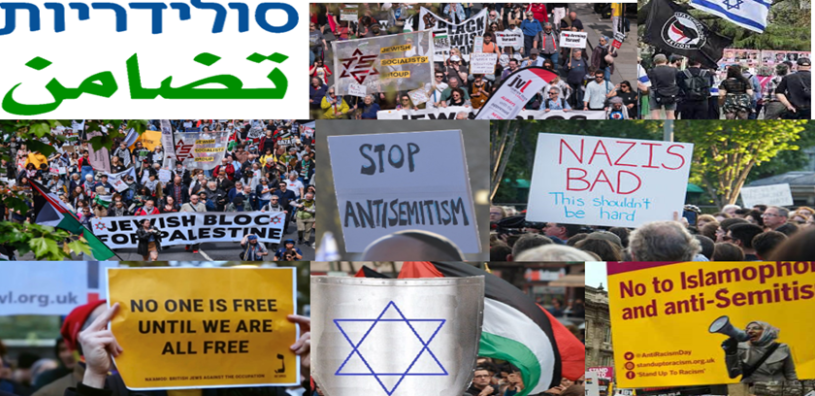
Mainstream politicians today are all in agreement that antisemitism is an evil that needs to be combated – even while making alliance with far right and authoritarian populist movements that themselves promote antisemitic narratives. The “Great Replacement Theory”, a conspiracy theory proposing that Jews are orchestrating mass migration from the global South, has become a stable of the rhetoric an increasingly mainstream right-wing politics. How can we respond to antisemitism without creating a hierarchy of racism? How can we build deeper solidarity between those in struggle against antisemitism and those in struggle against other forms of racism, including Islamophobia and anti-migrant racism? Can we build a politics of anti-antisemitism that is not carceral and punitive? How can we respond to the ways in which the right has used antisemitism as a political football in its culture wars against the left and against minorities in the UK? This webinar focuses on antisemitism in the UK as a form of racism, and how the anti-racist and migrant solidarity movement should respond to it. Building on earlier webinars on identity politics and culture wars, on the state imposition of definitions of racism, and on the criminalisation of protest (including Palestinian solidarity protest), in this session we build our analysis of contemporary antisemitism and suggests ways forward.
Nira Yuval-Davis, drawing on a book project with Ben Gidley as well as a previous article in Sociology, proposes that antisemitism can be understood as at the frontline of a multilayered, multipolar cluster of contestations. In her presentation, she will argue that antisemitism is anti-Jewish racism which, while having its own histories and genealogies, shares various racist perceptions and practices with other racisms, and highlight how the debates on the Palestinian question and contestations regarding definitions of racism and antisemitism are at the frontline of a much wider contestation between the global South and the global North on the boundaries of so called universal human rights and entitlements. But this contestation is paradoxically taking place just at the time when an even more basic contestation is taking place, with the rise of the global nihilist extreme right challenging the normative validity of any human rights and entitlements of those of outside a tiny privileged few.
Ben Gidley’s presentation will draw on a recent Perspectives paper he co-wrote for the Runnymede Trust with David Feldman and Brendan McGeever, Facing Antisemitism: The struggle for safety and solidarity. That paper argues that despite the prominence of antisemitism in our public debates, antisemitism remains poorly understood, and that our data on antisemitism needs to be examined critically. It proposes that a new strategy is needed to respond to antisemitism in the UK: a project of horizontal solidarity between minority populations rather than vertical alliances with the state.
Shabna Begum will draw the connections between this analysis and the wider anti-racist movement. The shocking rise in religious hate incidents is often only the tip of the iceberg of the kind of hostility and insecurity that many Jewish people will have experienced. At the same time, we have witnessed a deepening of division in the mainstream which has polarised and confused the issue. Rather than continue to insist that we are each others’ adversaries, and with the far right rising as a clear and visible danger to us all, we need an anti-racist solidarity that attends to antisemitism and racism in all its forms. Our government and political leaders need to stop using antisemitism as a convenient battleground on which to score wider political points, and instead attend to the deep danger and harm that antisemitism inflicts on Jewish people.
Speakers:
Nira Yuval-Davis is Professor Emeritus, Honorary Director of the Research Centre on Migration, Refugees and Belonging (CMRB) at the University of East London. She has written widely on intersected gendered nationalisms, racisms, fundamentalisms, citizenships, identities, belonging/and everyday bordering as well as on situated intersectionality and dialogical epistemology. Among her books are Woman-Nation-State (1989), Racialized Boundaries (1992), Unsettling Settler Societies (1995), Gender and Nation (1997), The Warning Signs of Fundamentalism (2004), The Politics of Belonging: Intersectional Contestations (2011), Women Against Fundamentalism (2014) and Bordering (2019).
Ben Gidley is a Reader in Sociology and Psychosocial Studies at Birkbeck University of London, a member of the Birkbeck Institute for the Study of Antisemitism, and previously a Senior Researcher at the Centre on Migration, Policy and Society at Oxford University. He is also a member of the International Centre on Racism at Edge Hill and a board member of the European Sociological Association’s Research Network on Racism and Antisemitism and the British and Irish Association for Jewish Studies. He researches antisemitism, Islamophobia, the far right and conspiracy theories.
Shabna Begum is CEO of the Runnymede Trust. She joined the Trust in 2021 as a Senior Researcher and worked her way up to become Director of Research before taking on the CEO position. Her work has been at the heart of all the Runnymede Trust’s recent projects, including our research on police in schools, the cost-of-living crisis, the experiences of women of colour in the workplace, and racism in migration debates. Her book From Sylhet to Spitalfields: Bengali Squatters in 1970s East London was published by Lawrence Wishart in 2023.
Chairs: Gwyneth Lornegan (Northumbria University), Ann Phoenix (UCL)
 Social Scientists Against the Hostile Environment